

When purchasing EMI shielding materials, fingerstock may look like a relatively simple component. However, selecting the wrong profile, material thickness, or mounting method can create problems during installation and operation.
Fingerstock is commonly used in shielded doors, electronic cabinets, RF enclosures, and removable access panels. Its purpose is to maintain electrical continuity between two conductive surfaces while accommodating repeated mechanical movement.
For procurement teams, engineers, and shielding system integrators, the main challenge is finding a product that matches both the electrical and mechanical requirements.
This guide explains what to check before purchasing an EMI fingerstock gasket and how to prepare a clear request for quotation (RFQ).
1. Identify the Application Before Selecting a Product
The first step is to understand where the fingerstock will be installed.
Different applications may require different contact structures and mounting methods.
Common applications include:
EMC shielded room doors: Fingerstock helps maintain electrical contact between the door and frame during repeated opening and closing.
Shielded cabinets: It provides conductive contact around removable covers and access panels.
RF enclosures: It helps maintain shielding continuity across mechanical joints.
Telecommunications equipment: It can be used at cabinet doors, equipment panels, and conductive interfaces.
Industrial electronic enclosures: It supports EMI shielding around equipment access points and removable structures.
Aerospace and defense equipment: It can be used where mechanical durability and reliable electrical contact are important.
The application determines the required profile, contact force, material, and environmental resistance.
2. Choose the Right Base Material
Material selection is one of the most important purchasing decisions.
Beryllium copper is widely used for fingerstock because it combines good electrical conductivity with excellent spring characteristics.
Its advantages include:
- High mechanical strength
- Good elastic recovery
- Fatigue resistance
- Electrical conductivity
- Suitability for repeated mechanical contact
- Availability in thin formed profiles
For applications involving frequent door operation, these characteristics can be particularly valuable.
Other conductive alloys may also be suitable depending on the mechanical and electrical requirements.
When requesting a quotation, specify whether beryllium copper is mandatory or whether alternative materials can be considered.
For products containing beryllium, normal handling of finished components should be distinguished from machining or abrasive processing, which can create hazardous dust or fumes. Any secondary processing should follow appropriate occupational safety requirements.
3. Confirm the Material Thickness
Material thickness directly affects the mechanical behavior of fingerstock.
Noordin’s published beryllium copper fingerstock specifications include three material thickness options:
| Option | Material Thickness |
|---|---|
| Type 1 | 0.08 mm |
| Type 2 | 0.10 mm |
| Type 3 | 0.127 mm |
A thinner strip may provide different flexibility and spring force from a thicker strip.
However, thickness alone cannot determine the actual contact force or allowable compression.
The formed profile, finger geometry, material condition, and heat treatment also influence performance.
When selecting thickness, consider:
- Required spring characteristics
- Available installation space
- Contact force
- Mechanical deflection
- Expected operating cycles
- Mating surface geometry
If you are replacing an existing product, providing a physical sample or detailed drawing can help the supplier identify the closest configuration.
4. Select the Correct Finger Profile
The fingerstock profile determines how the gasket contacts the opposite surface.
Before ordering, confirm:
- Overall profile height
- Base width
- Finger length
- Finger shape
- Contact direction
- Mounting structure
The correct profile must fit the available space and remain within its recommended working deflection range.
If the fingerstock is used on a shielded door, the door-frame gap should be measured at multiple positions.
For existing equipment, a photograph showing the original mounting position can also help the supplier understand the application.
Do not select a replacement based only on the external appearance. Two similar-looking profiles may have different spring characteristics and mounting dimensions.
5. Choose the Appropriate Surface Treatment
Surface treatment affects the durability and electrical interface of the fingerstock.
Noordin’s published product options include:
Natural Finish
Suitable for applications where the natural surface condition is compatible with the mating material and environment.
Tin Plated
A practical option for various general electrical contact applications.
Tin plating can offer useful corrosion protection, but its suitability depends on the contact materials and operating conditions.
Nickel Plated
Can provide improved wear and corrosion resistance for certain applications.
The contact characteristics and compatibility with the mating surface should be reviewed before selection.
When deciding on a surface finish, consider:
- Contact material
- Environmental humidity
- Corrosion exposure
- Wear requirements
- Electrical contact requirements
- Cost considerations
For example, a fingerstock gasket mounted on an aluminum shielding door may require a different finish evaluation from one used on a plated steel cabinet.
The finish should be selected according to the complete material combination rather than independently.
6. Confirm the Mounting Method
Mounting compatibility is another important procurement consideration.
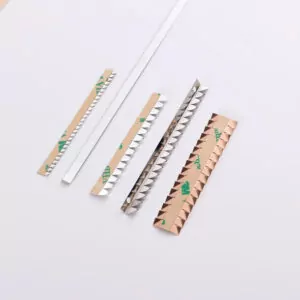
Noordin offers two mounting approaches for its published fingerstock product:
Snap-on mounting
This configuration is suitable for compatible supporting structures and allows the strip to be mechanically retained.
3M adhesive tape mounting
This configuration simplifies installation where a suitable adhesive mounting surface is available.
Before choosing, confirm:
- Mounting surface material
- Available installation space
- Required retention strength
- Operating temperature
- Humidity and environmental conditions
- Whether future replacement is necessary
For frequently accessed doors, mechanical retention may be preferable depending on the design.
For certain flat surfaces or retrofit applications, adhesive mounting can provide a more convenient solution.
Remember that the mounting adhesive is not a substitute for the conductive electrical interface.
7. Consider the Required Length and Dimensions
For long shielding doors or large cabinets, the required fingerstock length can become a significant part of the quotation.
Before purchasing, confirm:
- Total required length
- Individual strip length
- Number of pieces
- Cutting requirements
- Corner arrangements
- Joint details
- Installation orientation
If the fingerstock is installed around a door perimeter, calculate the complete contact length and account for corner transitions.
For segmented installations, consider how adjoining pieces will meet.
Uncontrolled gaps between strips can create discontinuities in the shielding interface.
For custom projects, a dimensioned drawing is preferable to a simple length description.
8. Check the Operating Environment
The surrounding environment affects the long-term reliability of fingerstock.
Important factors include:
Temperature: Confirm that the selected material and finish are suitable for the operating temperature.
Humidity: Moisture can increase corrosion risks, particularly when dissimilar metals are in contact.
Vibration: The mounting method should retain the fingerstock under normal operating conditions.
Mechanical cycling: Frequently opened doors require a suitable spring profile and fatigue performance.
Contamination: Dust, oils, cleaning chemicals, and other deposits can affect contact surfaces.
For industrial or outdoor installations, environmental conditions should be included in the RFQ.
9. Don’t Purchase Based on Shielding dB Alone
Shielding effectiveness is important, but a fingerstock gasket cannot be assigned a universal shielding value independent of its installation.
The final shielding performance depends on:
- Fingerstock profile
- Contact geometry
- Compression
- Mounting structure
- Electrical continuity
- Door or panel construction
- Frequency range
- Test configuration
A datasheet should be reviewed to determine what performance information is actually available.
If your project requires a specific shielding effectiveness, provide the target frequency range and test conditions to the supplier.
For Noordin’s current published fingerstock product, detailed insertion-loss data is not listed on the product page. Customers with specific performance requirements should therefore confirm the available technical information and verification options before ordering.
10. Standard Product or Customized Fingerstock?
Standard products can be suitable for many common shielding applications.
However, custom configurations may be needed when the existing enclosure has special mounting dimensions or when a replacement product must match an existing profile.
Customization may involve:
- Material thickness
- Profile dimensions
- Strip length
- Surface treatment
- Mounting arrangement
- Specific installation geometry
When requesting customization, provide a technical drawing whenever possible.
If no drawing is available, a physical sample, photographs, and measurements can help establish the required dimensions.
The supplier can then review whether the requested configuration can be manufactured.
11. How to Compare Different Fingerstock Suppliers
When evaluating quotations, do not compare prices without checking the technical details.
Use the following comparison table:
| Item | What to Check |
|---|---|
| Base material | Beryllium copper or alternative alloy |
| Material thickness | 0.08 / 0.10 / 0.127 mm or custom |
| Profile | Height, width, and finger geometry |
| Surface finish | Natural, tin plated, nickel plated |
| Mounting | Snap-on, adhesive, or mechanical |
| Dimensions | Length and mounting measurements |
| Mechanical performance | Spring force and working deflection |
| Documentation | Datasheet and outline drawing |
| Customization | Available profile and size options |
| Lead time | Production and delivery schedule |
A supplier that understands the installation requirements can provide more useful technical recommendations than one that only quotes a material thickness and length.
12. RFQ Checklist: What Information Should You Send?
To obtain an accurate quotation, prepare the following information.
Product information
- Required material
- Material thickness
- Fingerstock profile
- Surface treatment
- Mounting method
Dimensions
- Required height and width
- Total length
- Individual piece length
- Drawing or physical sample
Application
- Shielded room door
- Cabinet door
- RF enclosure
- Access panel
- Other shielding interface
Operating conditions
- Temperature
- Humidity
- Vibration
- Opening and closing frequency
Technical requirements
- Required shielding performance
- Frequency range
- Contact requirements
- Any relevant test specifications
Commercial information
- Quantity
- Delivery destination
- Required delivery schedule
- Packaging requirements
Providing these details helps reduce unnecessary communication and allows the supplier to prepare a more accurate quotation.
13. Noordin Fingerstock Product Options
Noordin supplies beryllium copper fingerstock for EMI shielding applications.
The published specifications include:
| Specification | Available Options |
|---|---|
| Material | Beryllium Copper |
| Thickness | 0.08 / 0.10 / 0.127 mm |
| Surface treatment | Natural / Tin Plated / Nickel Plated |
| Heat treatment | 370–420°C |
| Mounting | Snap-on / 3M Adhesive Tape |
| Dimensions | Customized according to requirements |
These options can support different shielding door, cabinet, and enclosure designs.
For projects involving replacement components, custom dimensions, or specific installation requirements, customers are encouraged to provide drawings or samples for technical review.
Conclusion
Choosing the right EMI fingerstock gasket requires a clear understanding of both the electrical and mechanical requirements.
The most important purchasing considerations include base material, thickness, profile geometry, surface treatment, mounting method, installation dimensions, and operating environment.
For frequently operated shielding doors and removable enclosure panels, the correct fingerstock design helps maintain reliable electrical contact throughout repeated mechanical operation.
Rather than choosing a product based only on appearance or price, confirm the actual installation conditions and technical requirements before placing an order.
Noordin provides beryllium copper fingerstock with different material thicknesses, surface treatments, and mounting options for EMI shielding applications.
Contact Noordin with your drawings, dimensions, or product requirements for technical assistance and quotation.
📌 Explore Noordin Fingerstock Products:
https://www.emcnoordin.com/product-category/shielding-materials-and-components/fingerstock-shielding-materials-and-components/
Learn more:
How to Select and Install EMI Fingerstock for Reliable Shielding Performance

