

In electromagnetic shielding systems, the enclosure itself is only part of the solution. Doors, access panels, removable covers, and mechanical joints can create gaps that interrupt electrical continuity and allow electromagnetic energy to leak.
This is where EMI fingerstock becomes important.
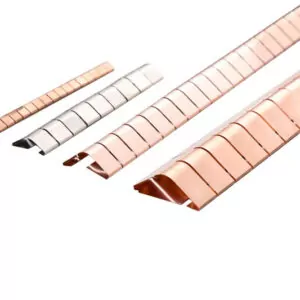
Fingerstock is a flexible conductive contact material designed to maintain electrical continuity between two mating conductive surfaces. It is commonly manufactured from beryllium copper (BeCu) and formed into a series of small spring-like fingers.
When a door or panel closes, these fingers compress against the mating surface, creating multiple conductive contact points along the joint.
Unlike a rigid metal connection, fingerstock can accommodate small mechanical variations while maintaining contact pressure.
It is therefore widely used in applications where electromagnetic shielding must be maintained while allowing doors and panels to open and close repeatedly.
1. Why Electrical Continuity Matters in EMI Shielding
A shielded enclosure works by providing a conductive barrier around sensitive electronic equipment.
For this barrier to perform effectively, electrical continuity must be maintained across its joints.
However, mechanical enclosures are not perfectly continuous structures.
They contain:
- Door openings
- Removable access panels
- Cabinet seams
- Hinged connections
- Inspection covers
- Equipment mounting interfaces
Even a relatively small gap can become an unwanted electromagnetic leakage path, particularly at higher frequencies.
A mechanical connection alone does not always guarantee a reliable RF contact.
Paint, oxidation, surface contamination, uneven pressure, and mechanical tolerances can all affect electrical contact.
Fingerstock helps address these issues by providing a flexible conductive interface that maintains multiple contact points between adjoining surfaces.
2. How Does Fingerstock Work?
The operating principle is relatively straightforward.
A fingerstock gasket consists of a conductive metal strip formed into repeated flexible fingers.
When the mating surfaces approach each other, the fingers deflect elastically and press against the opposite conductive surface.
This creates several parallel electrical contact paths.
The main functions are:
Electrical continuity: The conductive fingers connect two metal surfaces and help maintain the shielding path.
Mechanical flexibility: The spring structure accommodates small variations in surface alignment and enclosure dimensions.
Contact pressure: The elastic force helps maintain contact during normal operation.
Repeated operation: Properly selected fingerstock can withstand repeated compression and release cycles.
Some designs also create a wiping action as the surfaces slide against the fingers. This can help remove light surface films and maintain contact, although the amount of wiping and the resulting wear depend on the profile and installation.
The result is a flexible electrical connection suitable for frequently accessed shielded structures.
3. Why Is Beryllium Copper Commonly Used?
Beryllium copper is one of the most widely used materials for EMI fingerstock.
It combines electrical conductivity with strong spring properties, making it suitable for thin, flexible contact structures.
Its main advantages include:
Excellent Spring Properties
Beryllium copper can be formed into thin spring fingers that return toward their original shape after compression, provided the working deflection remains within the material’s elastic range.
This is particularly important for doors and panels that are opened frequently.
Electrical Conductivity
The material provides a conductive path between mating metal surfaces.
Although its conductivity is lower than that of pure copper, its mechanical strength makes it particularly useful for spring-contact applications.
Fatigue Resistance
Repeated mechanical operation can cause permanent deformation or fatigue in unsuitable materials.
Properly processed beryllium copper offers good resistance to repeated elastic deformation.
Compact Construction
Its mechanical strength allows relatively thin material to provide useful contact force, making it suitable for applications where installation space is limited.
These characteristics make BeCu fingerstock a practical choice for demanding EMI shielding interfaces.
4. Fingerstock vs. Conventional EMI Gaskets
Fingerstock and conventional EMI gaskets both help maintain electrical continuity, but their mechanical characteristics are different.
| Feature | Fingerstock | Conductive Foam Gasket |
|---|---|---|
| Main structure | Formed metal springs | Conductive foam structure |
| Contact behavior | Spring-loaded metal contacts | Compressed conductive material |
| Repeated opening | Suitable for frequent cycling when correctly designed | Depends on foam construction and compression |
| Contact force | Determined by spring profile | Determined by foam density and compression |
| Installation | Snap-on, adhesive, or mechanical mounting depending on design | Often adhesive-backed or mechanically retained |
| Typical use | Shielding doors and removable panels | Cabinet seams and general enclosure joints |
The choice depends on the application.
For example, a frequently operated shielding door may benefit from the spring characteristics of fingerstock.
A stationary enclosure seam may be better suited to a conductive foam gasket.
Neither solution is universally superior.
5. Different Fingerstock Profiles
Fingerstock is available in different shapes and mounting configurations.
The profile determines how the material contacts the mating surface, how much it can compress, and how it should be installed.
Common configurations include:
Single-Finger Profiles
These use individual spring contacts to provide a conductive interface.
They are useful where the available mounting space and contact geometry suit a relatively simple profile.
Multi-Finger Profiles
Multiple contact fingers provide several parallel contact points.
They can help maintain contact across a wider interface and accommodate certain mechanical variations.
Snap-On Fingerstock
Snap-on designs use a retaining feature that attaches to a supporting edge or mounting structure.
They are useful when a replaceable contact strip is required.
Adhesive-Backed Fingerstock
Some designs use pressure-sensitive adhesive tape for mounting.
This can simplify installation where mechanical fixing is difficult or where a dedicated retaining channel is unavailable.
The adhesive layer is primarily a mounting method. It should not be assumed to provide the electrical connection between the fingerstock and the enclosure.
The actual conductive interface must be designed separately.
6. Where Is EMI Fingerstock Used?
Fingerstock is used in many applications where two conductive surfaces need to maintain reliable electrical contact.
EMC Shielded Room Doors
Shielded room doors are opened regularly for equipment access and personnel movement.
Fingerstock can provide a flexible contact interface between the door and frame.
Shielded Cabinets
Electronic cabinets often contain removable covers and access doors.
Fingerstock helps maintain electrical continuity across these interfaces.
RF Enclosures
RF equipment housings require controlled electrical contact around panels and seams.
Fingerstock can reduce the risk of unwanted leakage through mechanical joints.
Aerospace and Defense Equipment
Electronic systems used in demanding environments may require lightweight, durable shielding contacts that tolerate vibration and repeated access.
Telecommunications Equipment
Communication equipment cabinets and RF modules may use fingerstock around access panels and conductive interfaces.
Industrial Electronic Enclosures
Inverters, control cabinets, and power electronics enclosures can also use conductive spring contacts to improve shielding continuity.
7. Why Installation Quality Matters
Even high-quality fingerstock cannot guarantee effective shielding if the installation is incorrect.
Several details should be considered.
Surface condition: The mating surfaces should be clean and electrically conductive.
Compression: The fingers must deflect sufficiently to establish reliable contact without being crushed beyond their permitted working range.
Alignment: The door or panel should close evenly along the contact interface.
Mounting: The fingerstock should be securely attached without damaging its spring structure.
Corners and joints: Gaps between separate pieces should be avoided or handled with an appropriate joint design.
Material compatibility: The finish should be suitable for the mating surface to reduce corrosion and galvanic compatibility problems.
The complete assembly should be evaluated rather than relying on the material specification alone.
8. What Makes a Good Fingerstock Design?
A suitable fingerstock design should balance several factors:
- Electrical conductivity
- Spring force
- Elastic deflection
- Mechanical fatigue resistance
- Contact geometry
- Surface treatment
- Installation method
- Environmental compatibility
A stronger spring is not necessarily better.
Excessive contact force can make doors difficult to close, increase wear, and damage the fingers or mounting structure.
Insufficient contact force can result in intermittent electrical contact.
The correct design must match the mechanical characteristics of the enclosure.
9. Noordin Beryllium Copper Fingerstock
Noordin supplies beryllium copper fingerstock for EMI shielding applications.
The product is designed for applications requiring electrical continuity, flexible spring contact, and repeated mechanical operation.
The published product specifications include:
- Material: Beryllium Copper
- Material thickness: 0.08 mm, 0.10 mm, and 0.127 mm
- Surface treatment: Natural, tin plated, or nickel plated
- Mounting methods: Snap-on or 3M adhesive tape
- Heat treatment: 370–420°C
- Customized sizes: Available according to project requirements
Different configurations can be considered according to the installation structure and contact requirements.
For shielded room doors, cabinets, and other EMI shielding interfaces, the fingerstock profile and dimensions should be selected according to the actual mechanical design.
Conclusion
EMI fingerstock is a relatively small component, but it plays an important role in maintaining electromagnetic shielding continuity.
By combining conductive metal with flexible spring geometry, beryllium copper fingerstock provides multiple contact points between mating surfaces and accommodates repeated mechanical operation.
It is particularly useful for shielded doors, access panels, RF enclosures, and electronic cabinets where reliable electrical contact is required.
Selecting the correct material, profile, thickness, surface treatment, and mounting method is essential for achieving dependable performance.
📌 Learn more about Noordin EMI Fingerstock:
https://www.emcnoordin.com/product-category/shielding-materials-and-components/fingerstock-shielding-materials-and-components/
Learn more:
How to Choose EMI Ventilation Panels for EMC Chambers and Shielded Enclosures

